
Harmonic Price Patterns in Forex: A Simple Guide for Traders

Harmonic price patterns are technical trading patterns that use Fibonacci retracement levels to find possible turning points in the market. These patterns help traders understand where price may reverse or continue after a correction inside a trend. Instead of guessing entries, harmonic patterns give a structured way to identify high-probability trade zones.
These patterns work best when markets move in waves. Price moves forward, pulls back, and then continues again. Harmonic trading focuses on measuring those pullbacks carefully.
The ABCD Pattern and the Three-Drive Pattern


The ABCD pattern is one of the most basic harmonic patterns. It forms when a price moves from point A to B, pulls back to C, and then moves again to D. Traders compare the size of the first move with the second move using Fibonacci retracement and extension levels. When both moves are similar in structure, the pattern becomes stronger.
The three-drive pattern is similar but includes three price pushes instead of two. Each move follows Fibonacci relationships. This pattern often appears near market reversals and can signal exhaustion in the current trend.
Both patterns teach traders how to read market rhythm using retracements rather than reacting late to price moves.
The Gartley Pattern
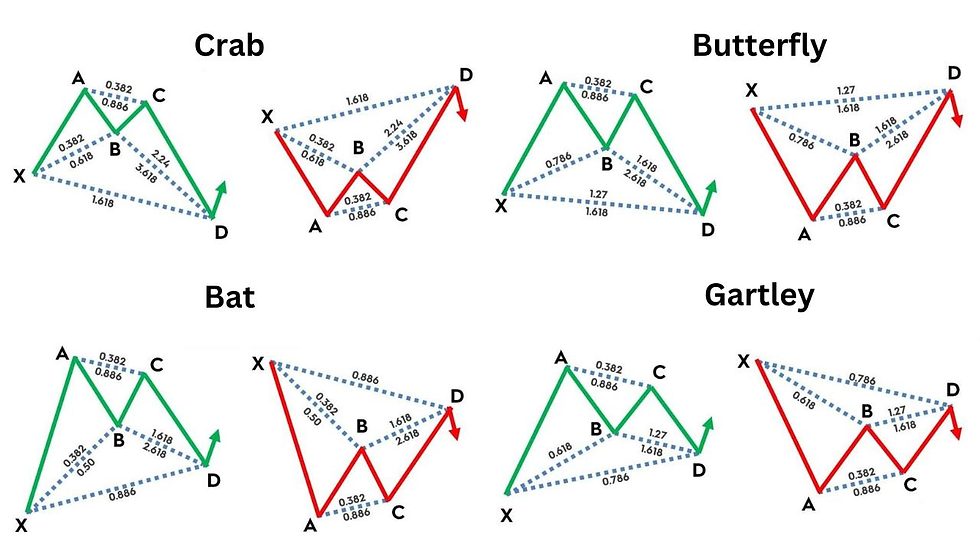
The Gartley pattern is a more advanced harmonic setup that helps traders answer two important questions: where to enter and when to enter.
This pattern forms when price follows a specific structure using Fibonacci retracement levels. Traders wait for price to complete the final leg of the pattern before entering a trade. The completion area often becomes a strong reversal zone because several Fibonacci levels come together in one place.
When used correctly, the Gartley pattern helps traders avoid entering too early and improves timing.
The 3 Steps to Trading Harmonic Price Patterns
Trading harmonic patterns follows a simple process.
First, identify a possible pattern forming on the chart. This usually looks like a zigzag structure with clear swing highs and lows.
Second, measure the swings using Fibonacci retracement and extension tools. This confirms whether the pattern matches harmonic rules.
Third, wait for the pattern to complete before entering a trade. Many traders enter too early and lose the advantage of the setup. Patience is important here.
Summary
Harmonic price patterns help traders understand retracements inside trends and locate possible reversal zones. Patterns like the ABCD, Three-Drive, and Gartley use Fibonacci levels to improve trade timing and structure. When traders learn to measure price swings properly and wait for pattern completion, harmonic trading becomes a powerful tool for identifying better entry opportunities in the forex market.

Comments